Thursday, October 28, 2010

Promoting Development

As I watch my English classes shrink, I wonder:

Did these students make a rational, informed decision that there time would be better spent elsewhere? Should I trust them and let them slip away into the night?

Or did I miss a page of my job description? One of my jobs is to help my community develop. As I discussed in my last post, development is increasing your abilities and opportunities (and sometimes, wealth). I've been teaching and organizing my neighbors. But maybe I'm supposed to be marketing to them as well.

If I can make my English classes more exciting--if I can make studying, investing, and contributing to the community more "sexy"--maybe our lives will improve faster. After all, my neighbors' decisions aren't entirely about business; they're also about their personal lives.

But there's a danger here, too. Is it really my job to get involved in these decisions?


Monday, September 27, 2010

Development

"Development" is a process a society goes through. When a society develops, its members gain more control over their lives. It's something like becoming wealthier and more productive, but not exactly.

Sometimes we divide the world into "developed" and "developing" nations. These aren't simply "rich" and "poor" countries; development's implications range from fertility rates to prevailing causes of death to education levels and family structures. Development isn't just for economists.

A lot of governments are concerned about how to develop their own countries. Some governments are also concerned about how to develop other countries, which is a different challenge and in some ways much more difficult.

I think development is mostly about strengthening institutions. If all the systems and organizations and ministries and government departments in a country are well-run, they can address their own problems. And they'll do so in a more efficient and more sustainable way than outsiders could. Sometimes this means training, sometimes it means loans, sometimes it means consulting. Sometimes it means benevolent neglect.


Schools
My town is full of development projects. The schools may be the strongest institution. Teachers are hired nationally by the Ministry of Public Education. They are then assigned to a town which may be very far from home (somewhat like Peace Corps volunteers!). Rural teachers face plenty of challenges, from limited resources to transportation difficulties, but they do their job admirably. They teach not only literacy but also values. School directors organize a PTA-like committee to administer school resources and raise funds from the community. It's good that the community gets involved. Were all the education funds simply sent from San José, there´d be less accountability. But because parents play such an important role in running the schools, the schools here are generally effective.


Local Government
Although most local government functions take place at the county level, Costa Rican towns have the option to form local town associations called "Asociaciones de Desarrollo" or "Development Associations." Any resident over 12 can be a voting member. They meet at least once a year to elect the council members, who have few special powers but can act as their own entity to speak on behalf of the town, to organize projects, collect funds, and request government assistance. These development associations are an important forum for people to talk together about their town's future. Typical projects include building and operating community centers and soccer fields, but can go as far as building a freeway. The downside to development assocations is that, like any exercise in participatory democracy, you need to get people to work together. They require strong leadership. This is a plus in that Development Associations help develop local talent and leadership. Without local leaders, how could development be sustainable?


Giving Things to Kids
The government gives out powdered milk once a month to mothers with young children in exchange for monitoring the child's health. In fact, Costa Rica offers a lot of grants to its citizens. IMAS, or the Institute of Mixed Social Help, offers scholarships to elementary and high school students to help defray the costs of living while in school. Under very limited conditions IMAS offers grants for improving homes or expanding businesses.

The milk program sounds a bit like a "conditional cash transfer" program--it's a payment for using government services. It's a big step up from just giving things away. When you give things away, it's hard to make sure they get into the right hands--and it's also hard to know if they do any good in the long run.


Me
And then there's me. Peace Corps' first goal is "Helping the people of interested countries in meeting their need for trained men and women." Although a liberal arts grad with no budget can only do so much, I think we've got a lot of advantages over writing a check. First of all, our limited funds force us to depend on the community. I'll only find support for the most important projects. And although Peace Corps volunteers have access to some external funds, I encourage my neighbors to look first at what they can do with their own resources.

So what am I doing so far?

Teaching English Classes


Teaching Computer Classes


Institutions
The most important thing I can do, though, is help people organize themselves and work together. When people are organized and determined, there's not much that can hold them back--not lack of resources, not lack of assistance from the outside.

Wednesday, September 1, 2010

Trees


A hundred years ago, this was pure jungle. Very Wet Tropical Forest (just shy of rainforest). There were no towns and no roads, although indigenous people lived here. Mostly there were trees.

There were a lot of kinds of trees. Up to 140 different species in the same hectare. Now we've cut most of them down. It's hotter than it used to be, and it rains less, and there's much more erosion. The river is more dangerous. Now we have roads and pastures and pineapples. We've kept a few patches of forest, though, especially around the streams. We're proud of our majestic trees. This one's a Ceibo.

TREE ECONOMICS

What story would an economist tell about our trees?

Are trees luxuries? A good trunk might be worth a thousand dollars, but instead of cutting it down my friend is proud of his Ceibo.

Are trees public goods? This Almendro is protected by decree of the government. Both Ceibos and Almendros are threatened species, and the endanged Great Grean Macaw depends on the Almendro.


Are trees a crop? San Marcos has thousands of hectares of tree farms, often non-native species like this teak. Monoculture is a problem, but at least it stops erosion. Strangely, it's often these tree farms, and not the primary forests, which receive "environmental service payments" from the government.


Who owns the trees? Many trees can't be cut down without government permission, and even if they fall down they sometimes rot on the ground because the paperwork required to take them out is too much trouble. If we de-regulated trees, we'd avoid that waste. We might even encourage more planting. But maybe we'd also have more trees cut down. We'd release the sequestered carbon (some of it--some might stay in furniture and houses, and some might be re-sequestered by new trees). We'll accelerate the desertification of Cutris. Tough choice.

Illegal logging is one of the top crimes in Cutris. Hey buddy, do you have a license for that log? When we catch tree thieves, the wood--on the road or still in the forest--is given to a nearby educational institution. They front the money to bring it to school property and store it there for up to six months as the paperwork is processed. Then they sell it. San Marcos's high school doesn't have the money or a full-time guard to watch the wood. But the high school in Boca de Arenal makes a lot of money. They might spend $2000 to haul the wood, but then they sell it for $30,000.


Tuesday, August 17, 2010

No Independence Day?

For the first time ever, Costa Rica's Atlantic port in Limón will remain open during Independence Day (September 15th) and other Costa Rican holidays.

This decision has pros and cons--it's a holiday the workers won't have off, but it's a day they can make more money, and an extra day to get your goods to market. But before you can compare the costs and benefits, you have to decide that holidays aren't sacred. You have to decide that holidays, too, can be subject to cost/benefit analysis.

Economic Anthropologist Stephen Gudeman (http://www.amazon.com/Economys-Tension-Dialectics-Community-Market/dp/1845455142) says that we make some economic decisions according to costs and benefits, while we make other decisions according to symbols, metaphors, and meaning. Deciding where to draw the line between these two realms is a constant struggle. Should we buy and sell sex? Should churches charge admission? Should you pay a friend when he or she gives you a ride? While every society has both market and non-market transactions, developed societies use more market-style cost-benefit analysis to make their decisions.

In my town in Costa Rica, families take care of their ailing parents, even if it means months when the caretaker rarely leaves the house. In the US we have a more efficient solution: outsource to retirement homes.

In my town in Costa Rica, things move slower. Time isn´t subject to the same cost/benefit calculus--instead, we greet everyone we pass on the street, we stop to talk to people who we don't, strictly speaking, need to talk to.

As a country develops, people make more decisions in terms of numbers and fewer decisions in terms of symbols and meaning. That can be a good thing--to a point.

Thursday, July 29, 2010

Art

I met a lady who turns peculiarly-shaped tree roots into sculptures. This doll has three legs, but is it cuter than the elephant?


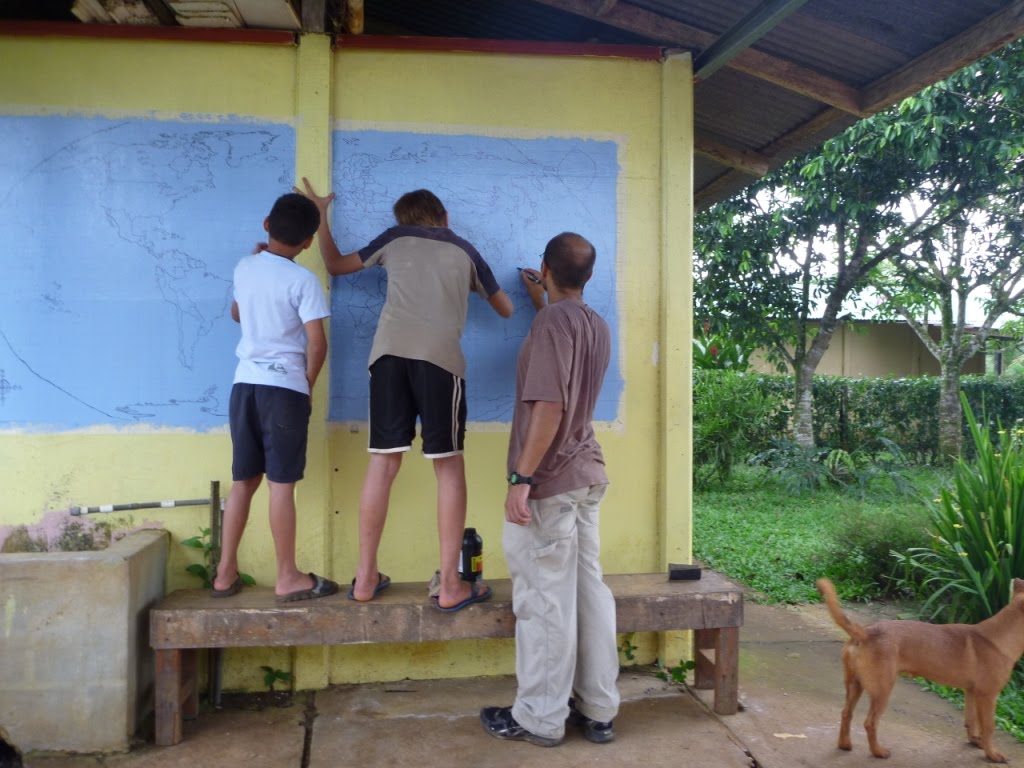
I helped the elementary schoolers paint a map of Costa Rica:


And the high schoolers paint a map of the world:


Next step: lessons on how to pose for a picture.


Is cooking an art? Judging by the hard hat you might think it's civil engineering. But at the least I can assure you that these tamales were engineered with love.


Wednesday, June 16, 2010

Life in the Campo

"Campo" is Spanish for "countryside." So, what's it like to live in the campo?

Food

We don't have a fruit bowl. Even if we did, I don't think these bananas would fit.


I went to learn how to milk cows... but turns out we've got a machine!
Dairy products here are fresh, but aren't pasteurized. If you don't drink milk the same day you have to freeze it.


Most people buy industrial bread--but some lades make bread at home in wood-fired ovens and sell it door-to-door.


The parrot approves of the homemade bread.


Bugs


Don't worry, the scorpions here aren't that bad.


I'm more worried about whatever it was that stung my hand.


Transportation

By foot, by bike, by horse, by bus...

Tree Day

Yesterday the high school invited me to lead a group of eighth graders in planting trees. It's fun to be a teacher when someone else plans the lesson!