For the first time ever, Costa Rica's Atlantic port in Limón will remain open during Independence Day (September 15th) and other Costa Rican holidays.
This decision has pros and cons--it's a holiday the workers won't have off, but it's a day they can make more money, and an extra day to get your goods to market. But before you can compare the costs and benefits, you have to decide that holidays aren't sacred. You have to decide that holidays, too, can be subject to cost/benefit analysis.
Economic Anthropologist Stephen Gudeman (http://www.amazon.com/Economys-Tension-Dialectics-Community-Market/dp/1845455142) says that we make some economic decisions according to costs and benefits, while we make other decisions according to symbols, metaphors, and meaning. Deciding where to draw the line between these two realms is a constant struggle. Should we buy and sell sex? Should churches charge admission? Should you pay a friend when he or she gives you a ride? While every society has both market and non-market transactions, developed societies use more market-style cost-benefit analysis to make their decisions.
In my town in Costa Rica, families take care of their ailing parents, even if it means months when the caretaker rarely leaves the house. In the US we have a more efficient solution: outsource to retirement homes.
In my town in Costa Rica, things move slower. Time isn´t subject to the same cost/benefit calculus--instead, we greet everyone we pass on the street, we stop to talk to people who we don't, strictly speaking, need to talk to.
As a country develops, people make more decisions in terms of numbers and fewer decisions in terms of symbols and meaning. That can be a good thing--to a point.
Tuesday, August 17, 2010

Thursday, July 29, 2010
Art
I met a lady who turns peculiarly-shaped tree roots into sculptures. This doll has three legs, but is it cuter than the elephant?


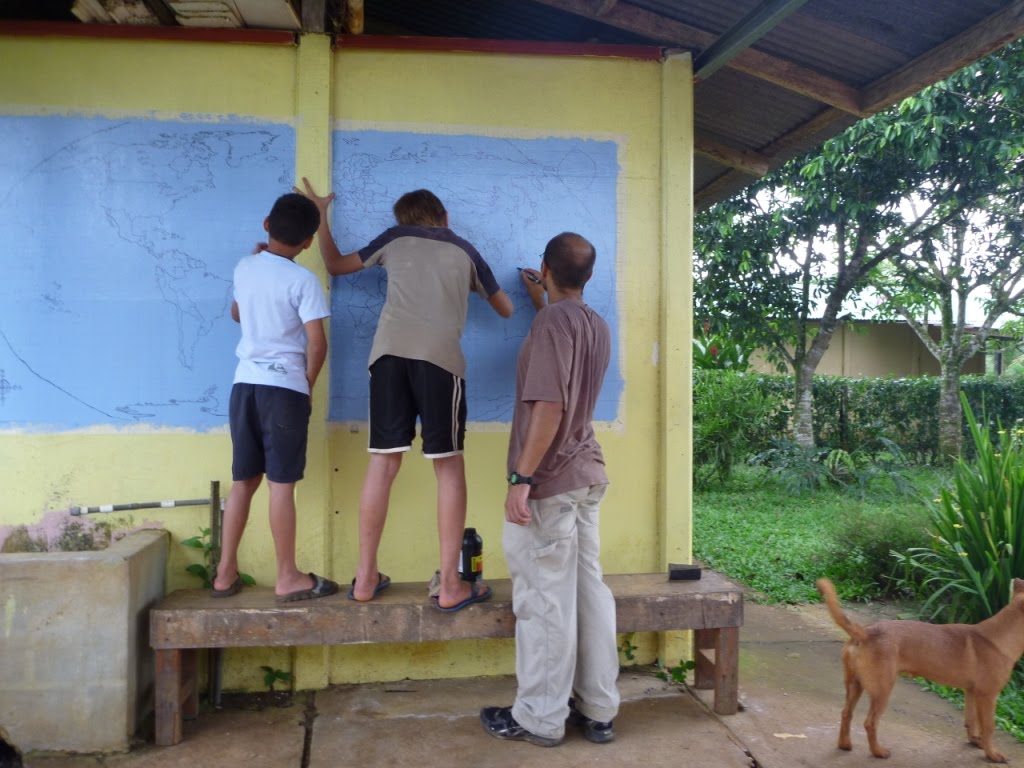
I helped the elementary schoolers paint a map of Costa Rica:

And the high schoolers paint a map of the world:

Next step: lessons on how to pose for a picture.

Is cooking an art? Judging by the hard hat you might think it's civil engineering. But at the least I can assure you that these tamales were engineered with love.

Wednesday, June 16, 2010
Life in the Campo
"Campo" is Spanish for "countryside." So, what's it like to live in the campo?
Food

We don't have a fruit bowl. Even if we did, I don't think these bananas would fit.

I went to learn how to milk cows... but turns out we've got a machine!
Dairy products here are fresh, but aren't pasteurized. If you don't drink milk the same day you have to freeze it.

Most people buy industrial bread--but some lades make bread at home in wood-fired ovens and sell it door-to-door.

The parrot approves of the homemade bread.
Bugs

Don't worry, the scorpions here aren't that bad.

I'm more worried about whatever it was that stung my hand.
Transportation

By foot, by bike, by horse, by bus...
Tree Day


Monday, May 31, 2010
My Town
I live in a small town in the district of Cutris, the county of San Carlos, the province of Alajuela, in Costa Rica.
I live in a wooden house.

We have three churches.

We have a soccer field.

We have a river.

We have a bull ring.

We have a computer center.

We have dirt roads.

We have chickens.

We have pineapple fields.


Farmer's Market

I met my new host family in San Jose at a farmer's market and helped them sell pineapple. Not only did I get to know the little yellow fellow quite well, I also had a chance to ponder the economics of farmer's markets.
Why do farmer's markets exist? If farmers specialize in farming, and stores specialize in selling, why would farmers try to do what stores do best? By selling retail instead of wholesale, farmers trade the certainty of contracts for risk, and loose the efficiency of transporting produce in large, refrigerated trucks.
Transporting produce in small trucks and selling it in a small stand requires more man-hours than using large trucks and large stores. Is the farmer's time just worth less than the professional driver's or clerk's? Do the farmer's markets exist only because farmers don't have access to jobs in the more productive full-time retail sector?
Or is it a transaction costs story? Farmer's markets are an example of vertical integration; by selling their produce directly, no resources are wasted in negotiations between farmers and retailers.
Farmer's markets also have a few advantages over traditional stores. Because the owner and the clerk are the same, prices can change quickly (not all markets are this efficient). If a farmer isn't selling enough, he can instantly lower the price. He has the freedom to bargain and price discriminate. Farmer's markets also offer a novel experience to consumers--from the colors and smells of the market to the chance to meet farmers and learn more about the products. And farmers have side benefits, too--instead of a professional truck driver hauling everything to the market, farmers can take advantage of travelling to buy products available only in the capital and visit relatives who live on the route.
Here in pineapple territory, a large pineapple is worth about 40 cents. In a grocery store in the capital it might cost $1.40, and in the farmer's market $1.00 (or, by the end of the day, $.80, $.60...)
Swearing In
 On May 21, 2010, the US Ambassador to Costa Rica Anne Andrews swore me and 51 trainees in as Peace Corps Volunteers. I was privileged to speak on behalf of the Community Economic Development volunteers.
Subscribe to:
Posts (Atom)


