Thursday, February 2, 2012

Welcome Letter


I wrote a letter for new Costa Rica CED volunteers. It's a start at trying to sum up the good and bad about the PC experience:

Dear Future CED Volunteer,

Congratulations! Peace Corps has chosen you for one of its most vibrant posts--where Peace Corps has served uninterrupted since 1963 and volunteers report high levels of satisfaction. While you miss out on the thrill of going to a Central Asian country no one has ever heard of, you'll find plenty of excitement in Costa Rica. It's yours for the making.

When I was in your shoes, I stayed up late reading everything I could find about Costa Rica. You probably feel excited, overwhelmed, and in the dark about what awaits you. Don't worry. No matter how little you pack or little you know, you'll have ample opportunity in Costa Rica to sort things out.

First, you'll spend several months "on parole" as a trainee. Peace Corps will watch your every move and squeeze every ounce of training they can into your culture-shocked brain. PST will drain and sometimes frustrate you, but you'll also enjoy the company of a good host family and start lasting friendships with your fellow volunteers.

After you swear in, the horizons will open and you'll suddenly feel far away from everything. But even in a small town, you'll find no end of people to meet, coffee to drink, or businesses to chat about. You won’t rush to start a killer project to double your town's GDP. Rather, you will take your time to make friends and sound out what projects might be feasible. You will follow your neighbors' cues, whether for an informal English class for high schoolers, business tips for store owners, founding a microfinance bank or teaching a women’s group to use Excel. The typical type-A CED volunteer will struggle to adjust to a new pace and style and pick him or herself up after false starts. But you will learn to work independently, set your own goals, design your own projects and--in many ways--be your own boss. And when you've been in site for a year, it may feel more like home than where you came from.

Life as a PCV will be what you make it. You could be busy every day or you could read 100 books. You could become a soccer star or organic farmer in your free time. Of course, you'll be the same you, and some days you'll feel that your life isn't that different here than in the States. But you'll leave Costa Rica with two years of wild stories, skills you never thought you'd need, and travels your homebound peers will envy.

Sincerely,

Alexander Douglas

Tico 20

Community Economic Development

Tuesday, March 8, 2011

The Mysterious Pulpería

My town, like most small towns in rural Latin America, has no grocery store or hardware store. We shop at pulperías. That's probably best translated as "general store." Think 7-11, except that it's owned by your neighbor and run out of her house. You can buy machetes or dried beans in bulk, but unfortunately no Taquitos.

Pulperías seem like a goofy system at first. My town of 400 has five pulperías, although two of them are limited to soda and junk food. The pulperías charge a uniform 20% markup with a few exceptions (rice, beans, oil, and flour are generally a 12% markup). Now, why would I need three convenience stores to sell canned tuna and dried beans for 10 or 20% above recommended retail prices? It's especially weird when the convenience stores don't carry the grocery items I need to buy frequently--fresh produce, for example. Why don't we centralize retail into a single grocery store in the center of town? Or, if we want to avoid a monopoly, if we don't have the scale to drive down costs, why can't we leave town every two months to buy dried goods and then shop at pulperías for produce and milk and other perishables?

Now I have a new theory. Amazon saves money over traditional retailers by keeping very little inventory in warehouses. Instead, producers manage their inventory. It's called Just-in-time inventory management. Maybe the pulpería system is similar. When you've got five or ten kids milling about your house, you can send one to the pulpería every time you need another egg or cigarette. And the pulpería will sell you a single egg for the same unit price as the kilo (yes, eggs here are by the kilo, not the dozen). Now as a housewife you don't have to tie up much money in "inventory" and you don't have to worry about storing ingredients or having them go bad. Maybe that's a more efficient way to handle shopping. And why don't pulperías carry produce? Simple--you can send your kids to buy it straight from the farmer. Unless it's a pineapple, of course. Then you can't buy it at all.


Monday, March 7, 2011

E-Commerce in Rural Costa Rica

My headlamp broke. Here it's not hard to buy a flashlight, or an el cheapo headlamp in Ciudad Quesada, but since I bike on rural roads I need a reliable, super-bright, hands-free, energy-efficient light. That leaves two options:

-11 hours busing to the Colombia store in the mall in Escazu, in San José
-Have someone mail me a headlamp

Since I'm a site rat, I chose the second option. Ah, glorious online shopping! So many options! But:

Hiccup #1: Amazon wouldn't accept my Costa Rican shipping address. But that's ok, because Sierra Trading Post did. Still sailing high: I get $10 off a $40 headlamp! And I've saved myself an overnight trip to San José!

Hiccup #2: Sierra Trading Post only ships by UPS. That's a shame, because they charge a $27 flat fee, whereas I've received padded envelopes of the same weight for $5 or $10 via normal mail. It's also a shame because I know both my mailmen by name (Edwin and Roberto), whereas UPS had to both call and email me to ask directions and coordinate delivery. I thought about asking a friend to buy the headlamp and ship it via normal mail, but I figured that just the time waiting in the post office wasn't worth saving $10 or $15. 

Hiccup #3: Import Duties. The Government of Costa Rica demanded $20 for the privilege of bringing the headlamp into the country. That's 67% of the headlamp's value. Maybe I should have asked a friend to send me a headlamp. If they opened the package and sent the "used" headlamp as a gift, I doubt it would have been subject to import duties. 

Hiccup #4: Costa Rica also charged me $40 for "Storage and Customs Services." 

Final price of the nominally $40 headlamp? $117, or 28% of my monthly budget. 

Sunday, February 13, 2011

Help me Design a Solar Dryer

For all you engineers out there--I'm going to build a solar dryer (for drying pineapple!) and I want your help. There are a lot of plans out there, but for simplicity's sake I've chosen the attached. Here are my questions--is this the right model for me? How should I tweak it? Would it make sense to replace the insulating material with something of higher thermal mass, like crushed glass, as one of my neighbors suggested?

I live 11 degrees north of the equator, near sea level. The sun is intense. Wind is limited. Annual rainfall is a little shy of 4 meters. Average temperature is somewhere around 23C. Annual evaporation is around 1.7 meters. Cloud cover is more than I'd like--but most days you get at least a few hours of good uninterrupted sun. When we get back into rainy season we might have to modify the dryer or choose a new design which we can run with firewood, but for the moment I'm hoping to keep this project green.

There are more dryer models here http://www.eric.ed.gov/PDFS/ED241766.pdf and elsewhere online.

Tuesday, January 18, 2011

Gifts

When a politician receives a gift, it's unethical.

When a Peace Corps Volunteer receives a gift, it's community integration.

I receive lots of gifts-especially pineapples and lunches. When my neighbors give me gifts they feel more comfortable receiving my free services, and I feel more welcome (and full). But I wonder-are my neighbors trying to pay me for services which I as a Peace Corps volunteer must provide for free? And do neighbors who feed me gain better access to my services in return? I'll certainly spend more time at their houses!

Wednesday, December 29, 2010

Happy New Year from Costa Rica

Cutting banana leaves to make tamales, a traditional Christmas food.

Happy New Year! I hope this year has treated you well and I hope the next one is even better.

When the year closes, I’ll have spent 304 days in Costa Rica, a little more than a third of my Peace Corps service. I’ve survived non-potable water, cold showers, limited internet, and more mud than I could have imagined. I’ve made countless friends—both gringo Peace Corps peers and Costa Rican and Nicaraguan neighbors, many of whom impress me with their generosity, intelligence, and hard work despite limited formal education. Although I miss family and friends, I’ve come to feel at home here, too.

I’ve had the privilege to try my hand at well digging, cow milking, English teaching, computer repairing, community organizing, papaya planting, school constructing, rice milling, and tamale making. I make my bread in a rice cooker, my pizza in a wood-fired oven, and pay a neighbor to wash my clothes by hand. Just as in the States life is mostly busy and often pleasant, although never before have I had the privilege of making so many decisions about my work and my schedule. During these months I’ve been struck by how difficult development work is and how much of it depends on the people. Although I’m proud of the work I do, I know I’m only a small piece of the puzzle compared to my neighbors who invest in their farms and shops, their children’s education, and their communities.

When the year closes, I’ll have 504 days more as a Peace Corps Volunteer. Keep in touch as I continue my service!

Tuesday, December 21, 2010

Buying Pineapple

It’s hard to buy everything you need when you live in a rural area. You’d think you could at least buy a pineapple, though. We have no shortage of pineapple—at 7.2 bushes per square meter and about half a year to grow a pineapple, I estimate we produce nearly a billion pineapples a year. So what happens when I set out to buy one?


Stores don’t carry pineapple. The local general stores, called “pulperías,” specialize in staples and shelf-stable goods. The closest you’ll get to fruit is a handful of onions and potatoes. So I take the other approach: I visit pineapple a pineapple farmer on Thursday, when they harvest in preparation for the weekend farmers’ markets. I ask if they’ll sell me a pineapple. Sell? They give me two. Despite numerous attempts, I cannot buy a pineapple. Nor am I able to receive only one—I’m always given two.


When I put on my economist hat, I don’t think of a gift as simply a gift. Even if it’s given with no expectation of returned favors, it’s still a symbolically significant transaction, and it forms part of a non-financial economy. I’m not sure why pineapple is treated this way; is it because they expect I’d steal it from the fields? Is it to avoid looking stingy? And is it equally strange of me to prefer buying a pineapple than constantly asking favors?


Maybe next time I’ll buy a thousand pineapples at once. Then I will pay—about 20 cents each!

Digging A Well

Thirsty? Start digging! Aside from a few neighbors who share a drilled well, each house has its own hand-dug well.


Find a high spot to dig your well, preferably not downhill from cow pastures, your latrine, or that spot in your backyard where you burn your trash. Get a shovel, rope and bucket. A typical well here is 8 meters deep, so I hope you’re not too thirsty just yet. Get some gloves to avoid blisters.


When you finish digging, you’ll build a concrete cap for the top of your well. You can leave mud walls as they are. If you have $500 to spare, splurge on a pump. If not, get used to that bucket!


If the water tastes funny one day, or if you notice bits of decaying rat in your bucket, you may need to clean your well. Drain it (good luck!) and pull out all the muck at the bottom. Hopefully you’ll find someone else to go down the well—although if you don’t mind toxic gases, claustrophobia, darkness and heat you can make a decent buck doing it yourself.


Water from your homemade well is “non-potable.”  I personally have had no problems. The Peace Corps volunteer here 20 years ago got Giardia six times, was medevaced to the States for a week, came back to find her house had been robbed, called the police, and is now happily married (with 2 kids) to the OIJ agent who came to investigate the robbery. She says she also lost a few pounds.

Saturday, December 11, 2010

Attitudes Towards Risk

When I watch how (and what) Ticos drive, I get the impression that they are more open to taking risks than Gringos. Ticos also have to deal with less predictable infrastructure, public services, and currency fluctuations. Ticos operate on a shorter economic timeframe, borrowing at high interest rates and often just scraping by. But risk acceptance isn't the whole story: Ticos are notoriously indirect comminicators, perhaps as part of a strategy to reduce the risk of conflict. Socially, they're relatively risk-averse. That makes sense when you might spend your whole life in a town with the same 300 neighbors!

(I know, these generalizations aren't quite fair)

Tuesday, November 23, 2010

Holiday Exchange

This year, Costa Ricans will celebrate Black Friday, although not with quite the same fervor or depth of discounts that we enjoy (or suffer from?) up North. And as Ticos crowd the stores, they'll have to weave between the abundant plastic Christmas trees.

It didn't occur to me that a country without Thanksgiving could still celebrate Black Friday. Or that a tropical country would invest in plastic evergreens. But with all the gringo tv we watch here, I shouldn't be surprised.

What's perhaps more curious is that some holidays transfer better than others. Was Thanksgiving left behind because it only works with an official government decree granting time off of work? Or was Thanksgiving left in the dust because no advertiser found a way to make money off of it?

Meanwhile, the US has yet to adopt any Costa Rican holidays. For those looking for new ways to celebrate, I recommend Juan Santamaría Day (http://en.wikipedia.org/wiki/Juan_Santamar%C3%ADa). Next April 11th, join your Costa Rican brothers and sisters in celebrating the defeat of William Walker, an American from Tennessee who took over Nicaragua in order to legalize slavery.

Latinomics

I've found a blog with a similar title and some interesting entries:

www.latinomics.org

Check it out!

Thursday, November 11, 2010

Attitudes Towards Time

I've set up Outlook so I can write an email message at home, press the "send" button, and relax knowing Outlook will automatically send the message when I connect to the internet later. But this is much harder to do with people; I can make plans in advance but people don't take them seriously. For a week I've been trying to organize a high school trip but it didn't come together until the last moment. It's as if the future were wild, untameable, better left to its own devices.

Living on a Peace Corps Budget

I'm getting ready to move into a new apartment. Living alone on a Peace Corps budget requires some adjustments. However, I'm lucky to have lots of helpful neighbors, which makes the process easier.

I've got three weeks to go and I'm making good progress. I've already got a gas stove, something like a sink, a rice cooker, an electric skillet, some mismatched tableware, and a promise of tables. And my fridge was delivered Monday!

Living alone should also help my projects. I can increase tourism in my community with a new tourist attraction: the world's most ghetto fridge.

Thursday, October 28, 2010

Promoting Development

As I watch my English classes shrink, I wonder:

Did these students make a rational, informed decision that there time would be better spent elsewhere? Should I trust them and let them slip away into the night?

Or did I miss a page of my job description? One of my jobs is to help my community develop. As I discussed in my last post, development is increasing your abilities and opportunities (and sometimes, wealth). I've been teaching and organizing my neighbors. But maybe I'm supposed to be marketing to them as well.

If I can make my English classes more exciting--if I can make studying, investing, and contributing to the community more "sexy"--maybe our lives will improve faster. After all, my neighbors' decisions aren't entirely about business; they're also about their personal lives.

But there's a danger here, too. Is it really my job to get involved in these decisions?


Monday, September 27, 2010

Development

"Development" is a process a society goes through. When a society develops, its members gain more control over their lives. It's something like becoming wealthier and more productive, but not exactly.

Sometimes we divide the world into "developed" and "developing" nations. These aren't simply "rich" and "poor" countries; development's implications range from fertility rates to prevailing causes of death to education levels and family structures. Development isn't just for economists.

A lot of governments are concerned about how to develop their own countries. Some governments are also concerned about how to develop other countries, which is a different challenge and in some ways much more difficult.

I think development is mostly about strengthening institutions. If all the systems and organizations and ministries and government departments in a country are well-run, they can address their own problems. And they'll do so in a more efficient and more sustainable way than outsiders could. Sometimes this means training, sometimes it means loans, sometimes it means consulting. Sometimes it means benevolent neglect.


Schools
My town is full of development projects. The schools may be the strongest institution. Teachers are hired nationally by the Ministry of Public Education. They are then assigned to a town which may be very far from home (somewhat like Peace Corps volunteers!). Rural teachers face plenty of challenges, from limited resources to transportation difficulties, but they do their job admirably. They teach not only literacy but also values. School directors organize a PTA-like committee to administer school resources and raise funds from the community. It's good that the community gets involved. Were all the education funds simply sent from San José, there´d be less accountability. But because parents play such an important role in running the schools, the schools here are generally effective.


Local Government
Although most local government functions take place at the county level, Costa Rican towns have the option to form local town associations called "Asociaciones de Desarrollo" or "Development Associations." Any resident over 12 can be a voting member. They meet at least once a year to elect the council members, who have few special powers but can act as their own entity to speak on behalf of the town, to organize projects, collect funds, and request government assistance. These development associations are an important forum for people to talk together about their town's future. Typical projects include building and operating community centers and soccer fields, but can go as far as building a freeway. The downside to development assocations is that, like any exercise in participatory democracy, you need to get people to work together. They require strong leadership. This is a plus in that Development Associations help develop local talent and leadership. Without local leaders, how could development be sustainable?


Giving Things to Kids
The government gives out powdered milk once a month to mothers with young children in exchange for monitoring the child's health. In fact, Costa Rica offers a lot of grants to its citizens. IMAS, or the Institute of Mixed Social Help, offers scholarships to elementary and high school students to help defray the costs of living while in school. Under very limited conditions IMAS offers grants for improving homes or expanding businesses.

The milk program sounds a bit like a "conditional cash transfer" program--it's a payment for using government services. It's a big step up from just giving things away. When you give things away, it's hard to make sure they get into the right hands--and it's also hard to know if they do any good in the long run.


Me
And then there's me. Peace Corps' first goal is "Helping the people of interested countries in meeting their need for trained men and women." Although a liberal arts grad with no budget can only do so much, I think we've got a lot of advantages over writing a check. First of all, our limited funds force us to depend on the community. I'll only find support for the most important projects. And although Peace Corps volunteers have access to some external funds, I encourage my neighbors to look first at what they can do with their own resources.

So what am I doing so far?

Teaching English Classes


Teaching Computer Classes


Institutions
The most important thing I can do, though, is help people organize themselves and work together. When people are organized and determined, there's not much that can hold them back--not lack of resources, not lack of assistance from the outside.

Wednesday, September 1, 2010

Trees


A hundred years ago, this was pure jungle. Very Wet Tropical Forest (just shy of rainforest). There were no towns and no roads, although indigenous people lived here. Mostly there were trees.

There were a lot of kinds of trees. Up to 140 different species in the same hectare. Now we've cut most of them down. It's hotter than it used to be, and it rains less, and there's much more erosion. The river is more dangerous. Now we have roads and pastures and pineapples. We've kept a few patches of forest, though, especially around the streams. We're proud of our majestic trees. This one's a Ceibo.

TREE ECONOMICS

What story would an economist tell about our trees?

Are trees luxuries? A good trunk might be worth a thousand dollars, but instead of cutting it down my friend is proud of his Ceibo.

Are trees public goods? This Almendro is protected by decree of the government. Both Ceibos and Almendros are threatened species, and the endanged Great Grean Macaw depends on the Almendro.


Are trees a crop? San Marcos has thousands of hectares of tree farms, often non-native species like this teak. Monoculture is a problem, but at least it stops erosion. Strangely, it's often these tree farms, and not the primary forests, which receive "environmental service payments" from the government.


Who owns the trees? Many trees can't be cut down without government permission, and even if they fall down they sometimes rot on the ground because the paperwork required to take them out is too much trouble. If we de-regulated trees, we'd avoid that waste. We might even encourage more planting. But maybe we'd also have more trees cut down. We'd release the sequestered carbon (some of it--some might stay in furniture and houses, and some might be re-sequestered by new trees). We'll accelerate the desertification of Cutris. Tough choice.

Illegal logging is one of the top crimes in Cutris. Hey buddy, do you have a license for that log? When we catch tree thieves, the wood--on the road or still in the forest--is given to a nearby educational institution. They front the money to bring it to school property and store it there for up to six months as the paperwork is processed. Then they sell it. San Marcos's high school doesn't have the money or a full-time guard to watch the wood. But the high school in Boca de Arenal makes a lot of money. They might spend $2000 to haul the wood, but then they sell it for $30,000.


Tuesday, August 17, 2010

No Independence Day?

For the first time ever, Costa Rica's Atlantic port in Limón will remain open during Independence Day (September 15th) and other Costa Rican holidays.

This decision has pros and cons--it's a holiday the workers won't have off, but it's a day they can make more money, and an extra day to get your goods to market. But before you can compare the costs and benefits, you have to decide that holidays aren't sacred. You have to decide that holidays, too, can be subject to cost/benefit analysis.

Economic Anthropologist Stephen Gudeman (http://www.amazon.com/Economys-Tension-Dialectics-Community-Market/dp/1845455142) says that we make some economic decisions according to costs and benefits, while we make other decisions according to symbols, metaphors, and meaning. Deciding where to draw the line between these two realms is a constant struggle. Should we buy and sell sex? Should churches charge admission? Should you pay a friend when he or she gives you a ride? While every society has both market and non-market transactions, developed societies use more market-style cost-benefit analysis to make their decisions.

In my town in Costa Rica, families take care of their ailing parents, even if it means months when the caretaker rarely leaves the house. In the US we have a more efficient solution: outsource to retirement homes.

In my town in Costa Rica, things move slower. Time isn´t subject to the same cost/benefit calculus--instead, we greet everyone we pass on the street, we stop to talk to people who we don't, strictly speaking, need to talk to.

As a country develops, people make more decisions in terms of numbers and fewer decisions in terms of symbols and meaning. That can be a good thing--to a point.

Thursday, July 29, 2010

Art

I met a lady who turns peculiarly-shaped tree roots into sculptures. This doll has three legs, but is it cuter than the elephant?


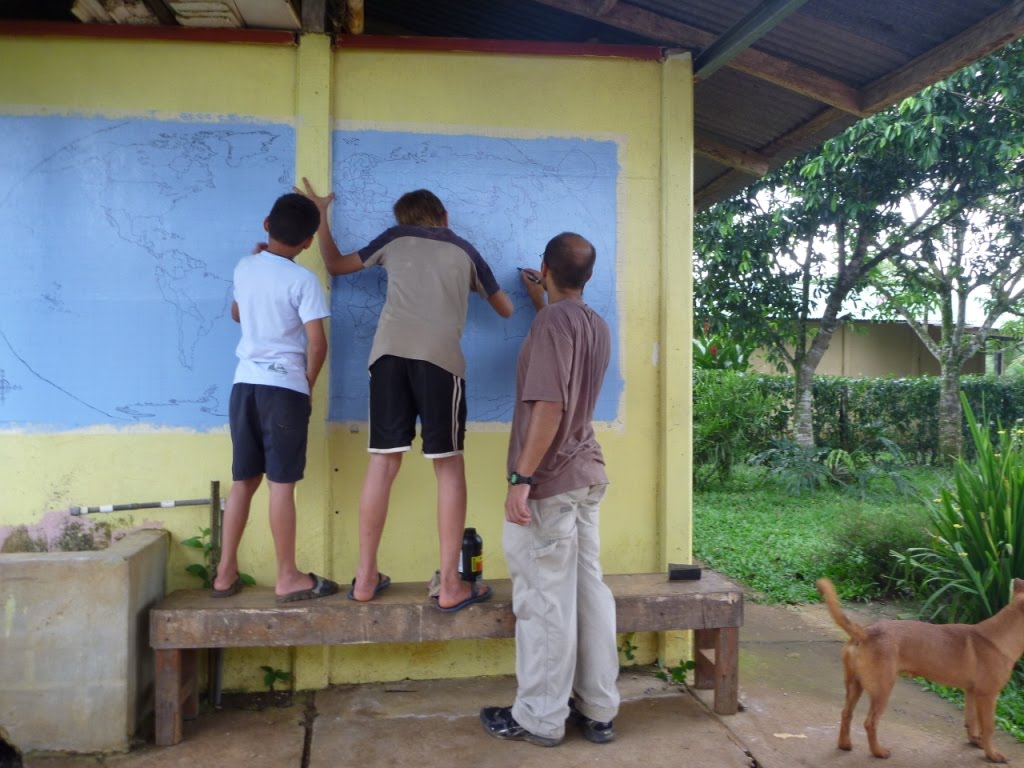
I helped the elementary schoolers paint a map of Costa Rica:


And the high schoolers paint a map of the world:


Next step: lessons on how to pose for a picture.


Is cooking an art? Judging by the hard hat you might think it's civil engineering. But at the least I can assure you that these tamales were engineered with love.


Wednesday, June 16, 2010

Life in the Campo

"Campo" is Spanish for "countryside." So, what's it like to live in the campo?

Food

We don't have a fruit bowl. Even if we did, I don't think these bananas would fit.


I went to learn how to milk cows... but turns out we've got a machine!
Dairy products here are fresh, but aren't pasteurized. If you don't drink milk the same day you have to freeze it.


Most people buy industrial bread--but some lades make bread at home in wood-fired ovens and sell it door-to-door.


The parrot approves of the homemade bread.


Bugs


Don't worry, the scorpions here aren't that bad.


I'm more worried about whatever it was that stung my hand.


Transportation

By foot, by bike, by horse, by bus...

Tree Day

Yesterday the high school invited me to lead a group of eighth graders in planting trees. It's fun to be a teacher when someone else plans the lesson!